5 Key Trends Shaping Agentic Development in 2026
The past year marked a genuine inflection point for agentic AI tooling. What began as experimental workflows has matured into a set of emerging standards and 2026 is shaping up to be the year developers demand that those standards actually hold. Here are the five trends we believe will define that journey.The past year marked a genuine inflection point for agentic AI tooling. What began as experimental workflows has matured into a set of emerging standards and 2026 is shaping up to be the year developers demand that those standards actually hold. Here are the five trends we believe will define that journey:
1. Improving Visibility and Management of Model Context Protocol (MCP)
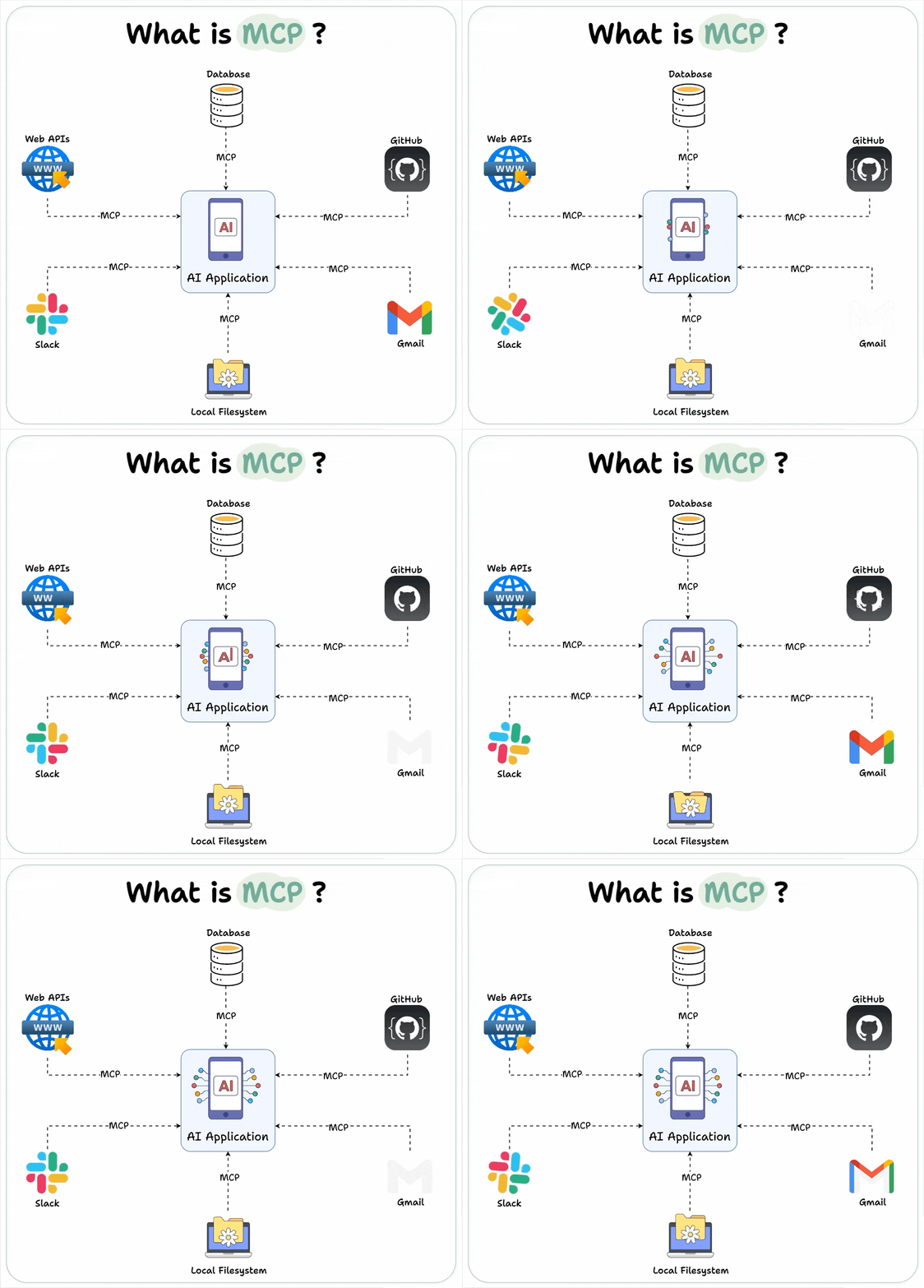
Image from albanna-tutorials
Model Context Protocol has rapidly become the accepted standard for how AI agents communicate with external tools and services. Its rise has been impressive but the operational reality of managing multiple MCP servers across a growing organisation is now catching up with the enthusiasm.
While developers have benefited enormously from the seamless connectivity MCP enables, governance around those connections remains largely improvised. Non-technical stakeholders increasingly want their AI-driven requests to plug into tools like Slack, internal databases, and business intelligence platforms. This democratisation of access is valuable, but it also means engineering teams will spend a significant portion of 2026 building, registering, and maintaining MCP integrations.
Expect to see centralised MCP management dashboards and clearer organisational policies emerge as enterprise adoption accelerates. The more useful MCP becomes, the more urgently teams will need structured oversight to keep it reliable and secure.
2. Supporting Parallel Task Execution for Senior Engineers
A growing category of tools now enables developers to define tasks and hand them off to an LLM running in the background, while simultaneously starting new work. This parallel execution model is no longer niche and it is becoming an expected workflow feature, and adoption is set to widen considerably through the year ahead.
Technically, parallel execution requires isolation between concurrent tasks. This typically involves creating a separate Git branch and working directory for each job — a pattern that Git worktrees handles cleanly — before merging results back into the main branch. It is a workflow that rewards experience: knowing when to trust an autonomous agent with a change, and evaluating the result quickly, are skills that take time to develop.

Image by Daniel Genezini
That is why parallel task execution, despite its apparent simplicity, remains most naturally suited to senior developers. The ability to field interruptions, in this case, asynchronous agent completions, while maintaining a coherent mental model of the codebase is a discipline, not a feature toggle. Teams investing in this workflow should plan accordingly.
3. Clarifying the Roles of Agentic CLI versus Desktop Applications
The emergence of Agentic Command Line Interface tools(programs that accept natural-language instructions directly in a terminal session), introduced a fundamentally new way of working. Built to run inside any shell environment, tools in this category feel immediately at home for developers already working from the command line, sharing context with the project directory from the moment they launch.

Image from geminicli.lat
In parallel, desktop-native versions of these same tools have matured to offer polished operating system integrations: native file browsers, refined request-and-response interfaces, and enterprise-friendly deployment options. Each approach has distinct strengths, and different teams have naturally gravitated toward one or the other.
The problem is that most providers have not clearly communicated how their CLI and desktop products relate to each other, thus leaving developers unsure about feature parity, support roadmaps, and which version to commit to for production workflows. In 2026, the expectation is that major providers will resolve this ambiguity and articulate a coherent story around both surfaces, rather than treating them as competing afterthoughts.
4. Integrating Paid Services and Agent-Driven Commerce
Truly autonomous agents eventually encounter a hard limit: payment. At some point, a task will require calling a billable service, spinning up a more capable model, or accessing a resource the initiating user has not explicitly licensed. The industry has no settled answer for this yet.
The concept is sometimes called the machine-to-machine economy: a model in which agents transact on behalf of users within defined parameters. Most developers approach this scenario with a mixture of pragmatism and scepticism. There is little appetite for agents spending money without clear human authorisation, but there is also recognition that an autonomous system that halts every time it hits a paywall is only semi-autonomous at best.

Image by GenX AI
This tension is particularly acute for developers running local language models who selectively route heavier tasks to more capable cloud-hosted models. Expect early frameworks for credentialled, delegated payments to begin appearing in 2026 which is cautious in scope, but a genuine start.
5. Addressing the Challenges of VS Code Forks in AI Development
A recurring pattern in the AI coding tool landscape has been the proliferation of applications that are, under the surface, forks of Microsoft's Visual Studio Code. The rationale is understandable: VS Code's extension architecture alone is insufficient for the deeper integration that language models require, so teams have opted to modify the source directly.
The consequences, however, are becoming harder to ignore. Independent extension marketplaces carry higher security risks. Diverging codebases require ongoing maintenance that many smaller teams are not resourced to sustain. And the strategic question of whether to build on a platform you do not control, indefinitely, eventually demands a clear answer.
The coming year will likely see more deliberate architectural decisions: whether that means deeper investment in independent platforms, closer collaboration with Microsoft, or entirely new approaches to IDE design built with AI at the core from the outset.
Looking Ahead: A Year of Consolidation
2025 was the breakout year for agentic AI tools, particularly those operating from the command line. 2026 is, by contrast, a year for proving that what was built can be relied upon. Developers are no longer asking whether large language models can write useful code. They are asking whether the tools built around those models can be trusted to support their workflows consistently, safely, and at scale. The teams and products that answer that question most credibly will define the landscape for years to come.